Wednesday, 8 April 2009

Hunger and Climate Change


Some practical solutions...

Tuesday, 7th April 2009

This climate change was organised by Practical Action, as part of a themed seminar. Almost one billion people in the world are hungry today. And the world’s population will continue to grow until it stabilises at nine billion in the middle of this century, by which time our food systems will have to feed 50% more people than they do today.

The panel consisted of Professor Robert Watson (Chief Scientist of DEFRA), Dr Saleemul Huq (Senior Fellow of Climate Change), Hilary Warbuton (Head of Practical Action’s work on food and livelihood security), and Patrick Holden (Director of Soil Association). This seminar looked into the underlying context of global poverty and environmental degradation as unchanged and the development of sustainable food supplies, and how climate resilient food system can tackle hunger in the developing world while reversing environmental damage.

Prof.Robert Watson talked broadly on the links with climate change and food security, touching upon common cause and implications of climate change to agriculture and farmers. A short background of the key components of climate change allowed Prof. Watson to elaborate on the need for governing better water and environmental system to cut on waste. Climate change has interrelation with increase in disease, heat stress, mortality, and decrease of water availability/quality, agricultural productivity... Food security is due to the increase of bio- fuel (particularly in the US), poor harvest, increase demand from China for example, high energy prices, speculation on commodity markets, and export bans from large exporting countries. Options for action included appropriate use of current technology, agro-ecological practices coupled with decreased post-harvest losses. We need to provide payments to farmers to maintain and enhance the ecological system. Prof.Watson stated that we have the technology to start this process. Gender empowerment of women is also particularly important to increase output and improvement in farming system and technology.

Dr Saleemul Huq used Bangladesh as a case study to discuss hunger and climate change. His review of the IPCC (4th assessment) suggested that the Mega-Deltas and Africa is an important focus for climate change and food security. With their low-adaptive capacities, these regions already struggle with food and climate change (hurricanes, glacier ice melting etc). At the global level, the UN convention on Climate Change is currently reviewing the Kyoto Protocol, and believes politicians are not brave unless civilians push these actions to the UN. It is difficult to develop global to local, therefore locals need to become empowered to push for change to a global level. Rich countries are not only responsible for climate change, but also rich people living in poor countries. However poor people in rich countries also suffer as illustrated by the devastation of hurricane Katrina in New Orleans. Rich countries are still unable to prevent climate change disasters or weaken its devastation. Formal negotiating groups are made up of poor countries – NAPA (National Adaptation Plan of Action) look at neighbourhoods which are most vulnerable to plan for action, however funding is short. Ingenious societies and knowledge need to be married with international planners.

Patrick Holden urged that nations need a strategic proof plan, whereby action is bottom up. There needs to be a total transformation of our food system. Other key elements were also mentioned in his speech.

Hilary Warbuton stated that small scale farming is normal in agriculture, and work in harsh conditions. Therefore, these farmers will be most familiar with the changes within their climate. Livelihood actions are limited and there is usually little or no finances available. The approach for climate change is for farmers to increase resilience, sustainability (socially and environmentally), manage risj, and increase the ability to change. It is not enough to chnage crops, but allow them to change a whole approach to livelihoods and systems.

Friday, 27 March 2009

United Nations MDG Award


On March 17th 2009, the world’s attention was focused on the United Nations as they paid tribute to individuals, organisations and nations working to implement the Millennium Development Goals (MDG). This prestigious award ceremony was held at the General Assembly hall of the United Nations headquarters in New York.


I was invited to this event by a friend. It was an unexpected opportunity - so I flew to America.

My first impression of the organisation of the event was bewildering. I was told security would be tight and needed to bring along several IDs. Furthermore, I was told that my partner Anthony was no longer on the gusts list prior to the event. After contacting a few people I know, only I got in. I felt it was appropriate to be dressed in a suit, in case I had the chance to meet a few UN diplomats. The place was heaving with UN officials, their name badges dandling around their necks.

The ceremony itself started late, but once it began, it was great. The concert had an array of musical talents and big names. Guests and celebrities included, Simply Red’s Mick Hucknall, Julian Lennon, Macy Gray and Sol Guy. Speeches were presented by Ambassador of Qatar, Nassir Abdulaziz al-Nasser, President of the General Assembly, Rev. Miguel d’Escoto Brockmann, and Executive Director of the UN Office for Partnership, Amir Dossal, who I had the pleasure of meeting again as well as his assistant, whom I’ve had contact with.

Awards were given to individuals who had enhanced the implementation and action of the MDG. The effectiveness of the MDG is incredibly important to decrease poverty, gender inequality, child mortality, diseases, gap between north and south and supporting the world’s poorest and vulnerable people to name a few.

Special awards were presented to Dr. Kevin Cahill, who received the Lifetime Award for Humanitarian Achievement, and to Archbishop Desmond Tutu, accepting the MDG Lifetime Achievement Award. Desmond Tutu’s speech was very colourful, which had the crowd applausing loudly.

Macy Gray performed “I Try” , getting the crowd to get up and dance in celebration. It was great to meet people working for the UN. My neighbour Maho was exceptionally nice. I got inside feedback about what it was like to work in the UN from people who actually worked there. It was also nice to be greeted by Amir Dossal since first meeting him in London.

The highlights of the MDG Awards Inaugural Awards can be viewed by clicking on this link:
http://iclips.net/mdg_awards_plist.html

Saturday, 14 March 2009

WILPF AGM: Gender Budgeting

Saturday 14th March

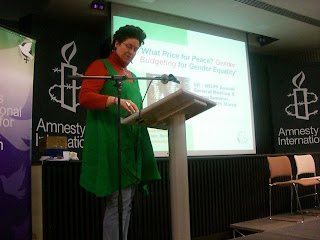
The WILPF UK AGM was presented by Vice Presidents Amy Barrow and Katherine Ronderos. Marion Boker, a consultant for Human Rights and Gender Issues from Germany, was invited to share a special presentation entitled “What Price for Peace: Gender Budgeting for Gender Equality.”
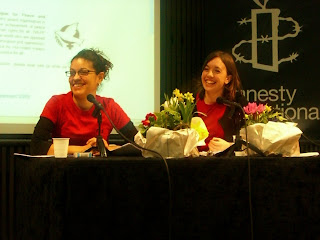
Summary of AGM

Members of WILPF celebrated the success of the Voices of African Women seminars, having networked with women from different countries. WILPF enabled women from Diaspora to engage with politicians in the UK and strengthen grassroot campaigns for the movement of African women in conflict. Having our campaigns assistant Sasha Jesperson on board has enabled WILPF to expand campaigning opportunities on a broader level. It was great to see interns and younger members on the executive committee, which should hopefully attract young women to join the organisation as active members. The ‘serious’ part of the AGM ended nicely with a musical rendition from Raised Voices, who are a political street choir.
Women of WILPF joined in with the singing about Palestine: “Free Palestine. What have they done? Take down the wall. Give back the land.”

Keynote Presentation

Marion Boker’s presentation about gender budgeting was quite a new angle, which neither I nor WILPF have much experience about. Boker stated that society needs social spending for health, better workplace, child care and education, as opposed to expenditure for war. Today, we have tools and enshrined rights to see that the government implement this. Finances for women’s needs are marginalised. In 2003, 0.04% of total European Commission Aid supported women-specific projects and programs, which clearly suggests that there is less for women and more for war. Failed budgetary on women is NOT an old metaphor. Figures for social spending have been constant from 1988 to present day, with only a small increase in 2002. Women have been fixed in traditional gender roles, such as looking after children and elderly – which of course earns women no money.

According to Boker, CEDAW are strongest on gender budgeting and are campaigning for this. The financial crisis is naturally offering new challenges which need to integrate around gender budgeting. Boker affirmed that the G7/G20 should be open for women and gender experts to implement an early warning system to crises and gender budget analysis for a more rounded conclusion. Violence against women, gender pay gap, unemployment and other situations are all increasing in stages of crisis and will continue to grow unless voices in parliament about these problems are heard.
A report in February 06 2009 from CEDAW in Geneva reported that:
“The UN Committee is concerned by the impact of the financial crisis on the rights of women and girls.”

This presentation has made WILPF consider gender budgeting and analysis into our general campaign and logistics.

Workshops

After the presentation, 3 workshops, which members of WILPF are working on, were present. The working groups below can be joined by anyone who is interested. Please contact the WLPF office or myself (about the VAW group) for more information: office@ukwilpf.org.uk

  • Women, Peace and Security
  • Global Economic Justice
  • Violence Against Women

As WILPFs co-coordinator of the Violence Against Women working group, I co-facilitated the workshop with Katherine Ronderos. We were fortunate to have two very special Sara Elizabeth Avilez Tome and Maria Amalia Reyes Cartagena from Honduras, to share their experience of violence. These women were in the UK for 2 weeks to raise awareness of gender violence in Honduras. Katherine led the discussion in Spanish, followed by English translations.

Before the interview with the women, a DVD was shown to highlight Sara Elizabeth’s experience, presented by 21st Century. Every 20 days, women are victims of physical abuse or killed by loved ones. Domestic violence is at an unprecedented level in Honduras and due to the level of cases, the police are being trained to think with a 'gender perspective' in order to handle the number of complaints. Furthermore, women are recruited into the police for thorough research and attention to these cases, as sexual violence was seen as a taboo.
Honduras has a population of 7 million people. Since 2007, 10000 cases of domestic violence were reported, which increased by 3.8% in 2008 but these numbers only reflect those who have reported it. Although the Honduran government have outlawed violence against women in 2007, the law is only now being implemented.

Response from the government has been limited and domestic violence is the last stage of action before women are assassinated by their spouse. Sara Elizabeth is working with women and NGOs to identify forms of violence and encourage other women to speak up about their experience before things can get worse.
The topic of patriarchy sparked fresh conversation. Participants suggested that new education need to be in place to teach children at a young age on how to treat people, eradicating old patriarchal attitudes. Sara Elizabeth and Maria agreed that the attitude of men wanting to be ‘more superior’ were spurred by old patriarchal influences and is still one of the biggest factors in Honduras. Women need to understand that these treatments and behaviour is not ‘normal’, and need support, education and awareness.

Sara Elizabeth and Maria are in partnership with CORN to strengthen community support at grassroot level in providing emotional support. Legal promoters provide training about legal instrument to report cases and support for long term processes. They hope to help women break the circle of violence based on economic dependency on their partner by starting micro-business projects like beauty courses, t-shirt making, tailouring etc. Current financial crisis makes it difficult to compete with imported products, which brings them back to their violent partners, however this is the beginning of a growing project, that can hopefully be encouraged by NGOs, and the government.

Sunday, 8 March 2009

Working for a world free of nuclear weapons


"Working for a world free of nuclear weapons – what can the United Nations and civil society do?”
CND Southern region meeting, Winchester
Saturday 7th March

Our chairman, Vijay Mehta, was invited by the southern region of CND to present a talk based on nuclear disarmament at their AGM. His wife Shanti and me as ACT-UN’s Campaigns Officer accompanied Vijay to Winchester, and it was the first time for the party to visit such a delightful town.

Despite being a small town, Winchester is packed with historical buildings and people young and old. When walking through the town to reach the meeting destination, it was welcoming to be surrounded by live music played by buskers and students alike. With these renditions, Vijay was more than ready to present his speech about what the UN and civil society can do about nuclear weapons.

The meeting was chaired by David Hougley, who is the treasurer of CD Southern Region. The event kicked off with Vijay’s speech, followed by the rest of the AGM after the break.

Before highlighting the current threats that nuclear pose in today’s world, Vijay most fittingly congratulated CND members in their efforts to campaign against nuclear. It is true that CND have been campaigning for a nuclear free world for over 50 years, however there is still a lot of work that needs to be done to innovate global disarmament. Vijay reflected how proliferation of nuclear in India, Pakistan, North Korea and Israel is inciting fear in civil society and causing political violence, becoming the “hallmark of new terrorism”. Nukes are continuously being upgraded, overlooking pledges signed in the Non-Proliferation Treaty (NPT) by major nuclear powers. Truth be known, nuclear weapons has no utility and only exist as a power symbol, which ironically only threatens security.

In an effort to incite positive action, Vijay reminded the audience of the 5 Point Proposal towards a nuclear free world, which was put forward by Ban Ki-Moon last year.

1/ Urge NPT states to fulfil their obligation under the treaty agreeing on a framework which is backed by a strong verification system (investment in verification R&D)
2/ Security Council to start dialogue to freeze nuclear weapon capabilities and make own disarmament commitments
3/ New efforts to bring a comprehensive nuclear test ban treaty into force without preconditions, by having nuclear weapon free zones
4/ Nuclear weapon states to encourage wider dissemination of information for greater transparency on use of obtained nuclear weapons
5/ New efforts against terrorism, limitation on nuclear production and trade, new weapons ban including missiles and space weapons

Permanent members of the Security Council are made up of nuclear state powers, nonetheless by enhancing Article VI of the NPT, signatories of the treaty are obliged “to pursue negotiations in good faith on effective measures relating to cessation of the nuclear arms race...under strict and effective international control”. However, the UN has much to do to prove they are more than just a ‘talk-shop’ in regards to committing to disarmament.

Civil society and organisations like ACT-UN and CND are more committed to envisioning a world without nuclear weapons. Vijay highlighted a 13 step action point to what individuals can do (please see main handout which can be found on the ACT-UN website). Many initiatives have been made by organisations in tackling and taking this issue to national and international parliament. Although there is a chance to prevent proliferation by limiting available sources, the UK and other nuclear powers have to recognise that their own weapons and policies are part of the overall problem. By uniting our voice into one, we can at least see that the UK acts to moving towards being nuclear free.

The presentation ended with a very active question and answer session, particularly rousing curiosity on how to encourage local mayors to become “Mayors of Peace”, which was initially started by the Mayor of Hiroshima. Remember, as Dalai Lama said “If you think you are too small to change the world, try sleeping with a mosquito”, which apparently one of Vijay’s favourite quotes.

Wednesday, 4 March 2009

International Dispute Settlement: Developments and Challenges

UNA Westminster

“International Dispute Settlement: Developments and Challenges”

7th Ruth Steinkraus-Cohen International Law Lecture

4th March 2009

This event hosted by the Westminster branch of United Nations Association was held at SOAS. I attended not because it was a large UNA meeting but for simple nostalgic reasons of revisiting my university, and had little knowledge of what the main event was about.

I was astonished to learn that the topic was on International Law and was co-hosted by the Bar Association. Therefore, over half the audience was made up of lawyers and I knew at that moment I would not understand the lecture.

Before the main speaker began, I was greeted by a man sitting in front of me. He was very welcoming and eager to know who I was. Little did I know, I was speaking to a Prince – Prince Mohsin Khan Ali of Hyberdad, and had given me his number asking me to call him early morning if given the opportunity. Also, I found two people within the crowd whom I recognised and knew me, which was great.

The lecture was given by Professor Maurice Mendelson QC, who specialises in public international law including international litigation, arbitration and negotiations with the government. He covered some historical context of the International Court of Justice with how inactive it was during the 60-70s compared to now. He spoke of the law side of the United Nations and how most states break or bend the rules if they feel they can get away with it. If that is the case, laws that have been implemented are not stringent enough to punish those that break the law at will, highlighting the problems and challenges of inconsistency. He stated that “International law is a fragmented system” as governments cannot force states to agree to treaties for universal participation, which is one of the problems. For example, no mechanism for law exists in Gaza, which caused great hardship for its people.

From what I gathered from this incredibly specialised lecture was that the development of international law requires evolution with United Nations aid. The UN is universal governmental body thereby international law should be strengthened and implemented accordingly within member states.

Wednesday, 25 February 2009

Annual Erskine Childers Lecture 2009


"Saving succeeding generations from the scourge of war"

Building a non-killing, non-violent culture for the human family

Erskine Childer’s memory is revisited annually by Action for UN Renewal. Erskine was a UN diplomat and the son of the 4th President of Ireland in 1993. This lecture had a great turn-out of around 120 attendees. Our chairman Vijay Mehta was one of the speakers, with guest speakers Nobel Peace Laureate Mairead Corrigan Maguire, welcome visit by Erskine Childer’s family, partner Marjolijn Snipe and son David Childers. Former BBC World’s Asian Editor and Chair of Commonwealth Journalist Association Rita Payne chaired the talk.

Vijay introduced the lecture illustrating how Erskine Childers was a “man with few illusions about UN flaws, shortcomings, and its need for reforms”, values which are followed through by Action for UN Renewal (ACT-UN). He went on to say that ACT-UN emphasises the UN’s successes but also recognises weaknesses embedded in the UN system. The obvious example Vijay used was the recent conflict between Israel and Hama, which failed to stop the war, despite repeated visits from the Secretary-General.

Marjolijn highlighted her life with Erskine while he was still alive, explaining how passionate he was for human rights, describing him as the “walking encyclopaedia” who had flowing knowledge. David was only 12 weeks old when his father died, but embraced that David has the same character as his father. Throughout her speech, Marjolijn used beautiful quotes to describe her husband, which nearly brought tears.

[Left: Talyn Rahman with Nobel Peace Laureate Mairead Maguire]

Mairead was very passionate when sharing personal stories with us about her family and the terrorist acts of the IRA, where three family members were killed. She stressed that we are spending too much time concentrating on one crisis after another and there seems to be no long term planning for peace. The United Nations deserves congratulations to their efforts, however it is incomprehensible why a joint declaration was made between them and NATO, who has no role in the world today nor will it ever be.

“If governments are serious about peace, we need to renounce war as an institution and disarm our world of all weapons of mass destruction” and instead build on a culture of non-militarism and strengthen that idea in the new generation. She urged “we need to look into our own life to root out violence” and “un-learn” many of our ideas alternate to violence.

It was incredibly moving how she talked about her experience in Gaza last year, illustrating how the Palestinians had no contact to the outside world because of closed borders by Israel and Egypt. She sat with a group of Hamas, who wanted to talk but no one was willing to hear them. The non-existence of basic human rights in Palestine breaks the Geneva Conventions, and said she can sympathise with both the Palestinians and the Israelis who are in the middle of an “ethnic political conflict” as her people in Ireland suffered years ago.
“We can’t be afraid of different cultures,” she reinforced, as her smile dropped, “When governments abuse these rights, we must stand up to protect them. This will be a daily and ongoing task...we as members of the Human Community must speak for the ‘silenced’ and support the United Nations and all freedom loving people to work for a nonviolent, nonkilling world based on human rights and freedom”.

Wednesday, 18 February 2009

The Media Magnet

I thought it would be fun to show an article from the Daily Mail, which I featured in. No name, no title, simple the fun loving Talyn dressed up in a Batgirl outfit to make a spectacle of herself in front of the media. I have featured in local newspapers in regards to demos, however this was a long time ago. I am sure there are others which I am not aware of.


I am getting a lot of media contact and experience working with Renu, and am building a list. Hopefully by the time I have completed my 'training', I should be even more media savvy to promote good causes. People from "Network for Peace" (an umbrella resource organisation for peace movements) have deemed to be 'a useful contact', and am starting to receive phone calls on how to market their organisation better, but I am in no position to do so, considering everything is new to me.

Originally, I wanted to be a business consultant, but one day, it would be nice to become a consultant for NGOs. This role is a working progress, and will continuously be developed as I learn more and meet people from a variety of background.

Thursday, 22 January 2009

Possible Partnership

Thursday 22nd January 2009

Thanks to my love for networking, I have managed to intrigue a researcher working for ‘Global Action Plan’ for future partnership with Action for UN Renewal. As the Executive Officer of ACT-UN, I arranged a business meeting, and am pleased to say that a few positive outcomes were agreed upon.
  • Global Action Plan have a charity partnership with Sky TV – shared resources for media coverage can be arranged
  • Research on climate change to be shared to enhance our book “Climate Change 365” before publishing and free national distribution
  • Bring together initiatives – employee engagement, Sky TV funding for research
  • Form relationship with Nick Clegg and the Green Alliance for advice and guidance to change civil society behaviour toward positive action of climate change

Sunday, 11 January 2009

Nick Clegg’s ‘Protect the Human’

Wednesday 10th December 2008

“Protect the Human” was organised by Amnesty International, to mark the 60th Anniversary of the Universal Declaration of Human Rights (UDHR). Nick Clegg MP, the leader of the Liberal Democrats, was the events key-note speaker, followed by a conversation with Adam Boulton from Sky News.

As the British Obama, Nick Clegg had touched upon all the issues which I believed were important. He emphasised how important it is for politicians to work closer with grassroot campaigners in bringing about real change in society, and how he would like to lead the country from a bottom-up approach.

[Right: Talyn Rahman with Liberal Democrat leader, Nick Clegg]

Clegg’s keynote began his speech talking about how the international landscape is testing the values of the UNDR: freedom, tolerance and, justice. Developed democracies are failing to meet those challenges across the world and in the UK. He believes the government cannot be proud on Human Rights Day as Britain is no longer part of the solution, but part of the problem. Millions of people still suffer abuse and cruelty and the growth of poverty, violence and repression is rapid.

“The world today is full of unprecedented threats and dangers,” Clegg confessed. He mentioned the spread of disease and the environmental crisis, and how the line is being blurred between military and civilian war. He stressed with great disappointment that western democracies are failing to restrain unwarranted aggression and this failure is the lack of political will.

Clegg had praised Obama for breaking barriers with America’s old enemies, ending the abuse of Bush’s administration and not hiding from America’s past. By combining this viewpoint, he believes that America will be able to move forward, leading the world to a better future, therefore making Obama a great role model for other politicians.

To the relief of British nationals, Clegg disagrees with the idea of carrying forced ID cards, which will make worse problems for asylum seekers and waste taxpayer money.
“So no ID cards,” he said, “Not for anyone. Not - as the Conservatives would have it - for foreign nationals but not British citizens.”

He touched upon the problem of refugees, forced marriages and women’s rights, as well as answering questions to the lack of human rights so clearly demonstrated by China and the Olympics. I shook his hands for wanting to form relationships with NGOs and strengthening their campaigns. I hope that working closer with a leader like Nick Clegg, NGOs will have greater power to engage with key decision-makers to allow change to happen. I hope that Nick Clegg is able to reach out to a wider audience and is able to persuade less-liberal minded people to engage with his politics and see him through to the next election.