In September of this year, ItsOneHumanity launched its Global Visual Petition Project for Climate Justice with the goal of giving young people a voice in the United Nations climate talks in Cancun. With the help of like-minded youth from around the world, they built a website with a visual petition system in 54 languages.
“To many of us young people, it made no sense that we were still approaching the issue of climate change as divided nation states, being fully aware of the potential damage it could have on our common planet and on everyone of us” says founder Elliott Verreault, 22, of Canada.
Over the past two months the petition has gathered more than 1,000 messages of support. You can watch a short video summary of their campaign progress so far at right.
Testimonials from ItsOneHumanity’s supporters show the depth and breadth of reasons why they’re calling for a global climate deal.
"Having witnessed firsthand the failure of the Copenhagen COP15 Climate Change Summit in 2009, I felt incredibly frustrated that world leaders were unable to look beyond their own national self-interest rather than to securing a binding treaty that benefitted the entire world” - Talyn Rahman, 25, United Kingdom
“World leaders need to realize that they represent global citizens when they sit in the conference. What we really need to do for climate justice is to have them take off their ego and think about real actions for our future generations. I would blame myself if my future children cannot live like they should.” - Sahid Priambodo, 19, Indonesia
The organization plans to present the signatures to representatives from the UNFCCC at the climate negotiations in Cancun later this month. If you want to add your name and support to the campaign, visit their website: ItsOneHumanity.org
Having witnessed firsthand the failure of the Copenhagen COP15 Climate Change Summit in 2009, I felt incredibly frustrated that world leaders were unable to look beyond their own national self-interest rather than to securing a binding treaty that benefitted the entire world. I was very pleased to join 'ItsOneHumanity' as one of the Regional European Ambassador. Training in diplomacy, I felt that the 'ItsOneHumanity' project was incredibly valuable in reaching out to young people from all over the world as a uniting voice to re-instate that we belong to one humanity.
As a team of young people ourselves, this project gives us a platform to remind people that we all serve a purpose to look after our planet - as one unit. Within a short space of time, the team of 'ItsOneHumanity' were able to draft a strong statement of solidarity for all to sign. This petition will then be presented to world leaders at the next global summit in Mexico as a form of lobbying. Whether or not they listen, this is a great opportunity for everyone to show that people across the world are in support for a better, protected world for now and the future.
To support this project, please spread the word and the sign the petition.
In July 2010, I was accepted by theJohn C. Whitehead School of Diplomacy and International RelationsatSeton Hall Universityto participate in an intensive training course at the United Nations Headquartersin New York. This unique opportunity enabled me to learn about the workings and political dynamics of the UN from a combination of 19 top-tiered UN officials and practitioners.
Since its creation in 1945, the UN is till the only organisation that brings together 192 nations as tact for political intervention and preventive diplomacy. Unique for its peacekeeping capabilities and humanitarian assistance, members rely on the UN when no other options are available to them. This is true of Africa as 70% of UN time is spent on African matters. As a member unit, 150 countries participate in peacekeeping by sending troops or contributing financially. Developing countries like Bangladesh and Ghana are leading in troop contribution, whereas members of theSecurity Counciland member donors like Japan concentrate their efforts in financial aid. Even then the UN is in a fragile state as a result of reduced political support and shrinking funds. In recent years, UN bases and blue-helmet troops have been attacked by terrorists as they no longer accept the UN as impartial party. Now, UN bases look more like armed camps which ultimately sends the wrong signal to rogue actors.
The biggest scepticism shown towards the UN is surprisingly by the United States. BeforeBarack Obama’s presidency, the tone of US statements was confrontational and self-serving. US public opinion of UN work was superficially shallow and widespread. In an effort to shift public attitude of the US-UN relationship, President Obama has opened up engagement with the UN by resuming financial support to particular UN missions, and accepting to host the 64th General Assemblythis September. Nevertheless it is clear that the UN is doing a poor job in relaying positive news of its missions to the public. The most current media spectacle is generated aroundSecretary-General Ban Ki Moon’spublic perception. A week before this training, a highly controversial document known as theAlhenius Memohad described Moon as being a spineless, deplorable leader compared toKofi Anan. Depicted as the “invisible man”, UN members are pondering whether Moon was the “wrong” Asian candidate for the job. This week, officials have confirmed that Moon is likely to secure a second term in office, unless China and Russia change their mind.
On a positive note, the UN is leading on “global goods” issues such as emissions of greenhouse gases, global health, and cross-bordering diseases. One of the biggest focuses for many UN offices is theMillennium Development Goal (MDG). While the main MDG targets will not be met in 2015, the general poverty level has been halved since its initiation. In collaboration with corporations, theUN Office for Partnershipis working to leverage investment in developing countries so that local governments can establish social security for its people through infrastructure, governance, and education. The three pillars of the UN–development, peace and security, and human rights– is central for rebuilding a failed nation. However, many practitioners have argued that these pillars exclude underlying problems that inevitably lead to insecurity. Like a vicious cycle, human security cannot be sustained without tackling poverty, corruption, human and drug trafficking, preventable diseases, deforestation, climate vulnerability, arms trade, and gender discrimination. Much of the poor rely on these methods to survive. Development cannot happen without combating weaknesses that can potentially break the political infrastructure. The UN must integrate these issues into the three pillar system, or else root problems will continue to hinder any achievements.
Stigma and discrimination is the biggest killer for change, specifically for issues linked to HIV/AIDS, women’s rights, trafficking and global health. According to the UN Secretariat office, about 33.4 million people are living with HIV of whom more than 30 million live in low and middle-income countries. There has been a decline in AIDs due to prevention education to help change attitude of sexual behaviour in African youths, yet the problem is being crossed over border through human-drug trafficking and the sex trade. This is certainly true of Eastern Europe. Currently, Russia is giving no money to HIV prevention owing to stigma and discrimination barriers. Even the US still suffers from HIV stigma dating back from 1981, when the disease was called the “gay cancer”. In relation to the MDG, mothers are most stubborn in allowing their children to be vaccinated in fear that the needles will make their child sicker. Nigeria has the biggest number of polio as mothers are unwilling to immunise their children due to cultural and religious beliefs.
Involving women in the political and educational development is becoming ever more important. AlthoughSecurity Council Resolution 1325 (SCR1325)was initiated to involve women in all aspects of decision-making, it seems that even the UN is slow to adopt. Currently, there are 21 female ambassadors to the UN, and 5-6 women are leading peacekeeping operations. This is an improvement but taking into account that 192 countries are UN members, such a number is far and short off target. When considering applicants for a senior position, 1 out of the 3 recommended candidates must be a woman. The author of the Ahlenius Memo was shortlisted for top appointment but she refused as felt discriminated to be shortlisted because of her gender. The question begs whether female appointment is an issue of equality or a struggle over principle or power. Ban Ki Moon supports SCR1325 but without NGO pressure, implementation will continue to be side-stepped by member states.
During training, the biggest surprise for me was to learn about theUN Democracy Fund. This office was set up in 2005upon Kofi Anan stating that democracy is a human right. This is all well and good but as a Western concept, I doubt that democracy will be accepted as a norm for every society. China is a clear example. Chinese foreign policy revolves around compromise and this is evident in their peacekeeping contribution. Anan had defined the basis of sovereignty as ruled by the people and if the sovereign violates their rights, the UN has the right to intervene. China may not agree with this definition, but as a compromise to support conflict prevention, China is willing to contribute troops. Democratisation is an internal matter. The agency cannot do its work without the aid and support of local governments and civil society. At present, 4200 NGOs are accredited to the UN. UN staff is too few and resources are limited, therefore the UN rely on NGO relationship to drive and support the organisation. It is clear that the best way to work with the UN is to join a UN-accredited NGO.
For more information on how to work for the UN and the speakers I have met, please email.
As part of our diplomatic training, professors of Al-Akhawayn Universityhad opened our eyes to domestic and foreign issues related to Morocco and the Middle East. Together with classroom training and visits to the Moroccan Parliament, and Ministry of Foreign Affairs in Rabat, I have compiled a short summary of what we have learnt on Moroccan and Middle Eastern Politics.
The Middle East is made up of 21 countries, 16 of which are ruled under the single party ‘populist authority’, or the family-ruled monarchical regime. Morocco falls under the monarchical political system, whereby the King is constituently the overriding political decision-maker. As the direct descendent of Prophet Muhammed(pbuh), Morocco’s current sovereign HM King Mohammed VI is also recognised as the Head of Religion. Educated with a law degree, the King has the expertise to modify Islamic law to modern circumstances, which is unlike many Islamist state.
Domestically, the King is favourable for the improvement of women’s rights. After decades of protests by feminist organisations, the King has supported the reformation of the ‘Family Code’ which ensures that women become men’s partner in rights and obligation. Reforming the Moudawanahas enabled women the right to divorce, retain property, pass national rights to her children, and increase the minimum age of marriage to 15. However, even with these changes, women’s freedom of movement remains restrictive especially in rural areas. Morocco has one of the highest illiteracy rates (80-90% of all ages) and is still 47% rural. The law says that everyone must attend school, however the mixture of French, Arabic, Spanish and local Berber dialect makes educating the nation a difficult process. Universities remain available for the elite, which leaves the rest of the nation behind. Furthermore, the implementation of laws is quite a big problem. For example, the law states that alcohol is forbidden, yet the purchase of alcohol is readily available.
On an international level, Morocco prioritises its foreign agenda around counterterrorism, the unification of the Maghreb, andthe Western Sahara. It is quoted that 17% of Al-Qaeda organisation is from Morocco, however Moroccan officials were in denial that terrorism could ever affect them. Such thinking changed when a bomb exploded on May 16, 2003 in Casablanca. Since then, Morocco has been cooperating in counterterrorism strategies in North Africa, and has even issued special permission for the US to keep military bases on its soil.
Our visit to the Ministry of Foreign Affairsin Rabat confirmed that the issue of Western Sahara and the Maghreb Union is much complex. Western Sahara is seen as a geo-political issue between Algeria and Morocco, however Morocco had withdrawn from the African Union as they did not support Moroccan claim over the Western Sahara enclaves. People of the Sahara would prefer to be independent yet the right for self-determination is clearly not acknowledged by either party. Similarly, the issue of the Maghreb Union is unlikely to be resolved. The unification of the Northern African region (between Tunisia, Morocco, Algeria, Libya and Mauritania) became homogeneous after French colonisation, however each nation have conflicting interest that fail to keep the alliance together. A diplomat at MOFA told us that such issues will be resolved once the problem between Palestine and Israel subsides, hinting that these security matters will continue for some time.
As one of the most popular tourist destination, I was excited to experience a weekend in Marrakech. At first, I didn’t understand what was so fascinating about this city until we were bombarded by countless palm trees and camels, the scorching 50°C heat, and the vibrant and populated ‘suk’ (marketplace) that seemed to amplify the Morocco’s exoticness.
Unlike Rabat, the trip to Marrakech was purely for pleasure, despite the unbearable heat and 2-day bus ride from Ifrane. As part of the tour, we visited the Bahia Palace designed by the architect Muhammad al-Mekki of Marrakech, the Royal Tomb, the olive garden, and the Medersa Ben Youseff. The architecture of the Medersa Ben Youseff mosque was incredibly beautiful. The traditional Islamic art sculpting of the walls and ceilings truly added an ornate feeling to the already serene and beautiful monument.
Apart from the traditional sightseeing offered by Marrakech, I felt intrigued to explore the famous suk – the Jamaa-El Fna Square, where you can watch snake charmers, storytellers, henna artists and musicians. We came here twice, once in the dead heat of the afternoon and then in the more comfortable evening, which was when the marketplace came to life. A quick walk through the square would take 20 minutes on average with the constant distraction of local traders desperately seeking attention away from their competing neighbours. As a country that is extremely reliant on the tourist trade, the suk is the perfect tourist trap. We were warned by our tutors that Marrakech would be filled with imitators who pretend to be the Blue Men of the Desert, like the man I met in Chefchaoen, and to not buy items blindly without haggling down the price.
Considering that I live in a London borough scattered with Indian fashion stores, negotiating prices for goods wasn’t a new concept for me. However I recognised that my British upbringing in being polite to avoid confrontation made me an ineffective haggler. Although the prices of many items were jacked up for tourist, I felt guilty in persuading traders to knock off £2-5 off my purchase when I knew I could afford it. My colleague, Anca Sol from Romania, had a very different approach in to negotiating, which I have dubbed the ‘straight-shooter negotiation technique’.
The ‘straight shooter’ technique is a very direct approach – you name a price without any room for negotiation, full stop! If the trader disagrees with the price, you walk away and look elsewhere. The advantage of this technique is that it is 100% effective if the right pressure is applied. However, such a technique can quickly lead to an ill-feeling of anger by the other party to the point where they will never want to do business with you again. The ‘straight shooter’ technique isn’t for everyone – and it most certainly wasn’t for me.
This “trip to the North”was an exciting spur-of-the-moment opportunity after our scheduled weekend to Rabat was cancelled. I quickly became excited with the idea of hiking and touring in the deep valleys of the Northern Moroccan borders even if the decision to participate was sudden. The two day tour included hiking and swimming in Cabo Negro beach, Akshour, and Chefchaouenwith 52 students including 15 exchange students.
The journey to the North began at 1.30am on Saturday where we drove approximately 7 hours to our first destination. Cabo Negro beach in Tetouanis close to the borders of Spain, therefore the Spanish language (instead of French) was widely spoken in this region. After a short break for breakfast, we arrived at the beach, which was deserted largely due to the cold wet weather. Our so-called ‘beach day’ lasted only 30 minutes before the temperature dropped and the skies opened up to torrential downpour.
Disappointed, we returned to the mini vans to travel to our next destination – Chefchaouen, where our accommodation for the night awaited us. As we left Tetoun, I was amazed to see the city littered with the Moroccan flag. Every few yards, another set of flags waved in the air. We were told that the King Mohammed VIhad visited Tetouan a few days ago, and it is a tradition to decorate the town with its national flag and colour for the special visit. It is apparent that the King of Morocco has great executive power in the country more so than the Moroccan Prime Minister. Security forces in uniform are seen everywhere. While police presence indicates the autocracy of the nation, the sheer volume of security actually makes me feel safe in this country, especially when terrorism is a major problem.
In the local Berber language, Chefchaouen means “the horns” - I presume, of the mountains, which was exactly what we saw when driving through the valley. The scenery was spectacular with the additional treats of seeing farmers ploughing the land, people riding donkeys and even some locals waiting by the roadside for a hitch-hike. The town of Chaouen is well-known as the ‘blue city’ – all the buildings are painted sky blue, which brings about an immense sense of calm to the general atmosphere. I was surprised with how touristic the town was and even more surprised with just how windy it was. It felt like a typhoon but we still managed to explore cute little stores that sold very interesting handicrafts and jewellery. I was in awe of our accommodation –Casa Hassan– which looked like a room from an Arabian fairytale. I also met a man who was apparently from the desserts of Morocco. He seemed quite taken by me being ‘dark-skinned’ – I get mistaken as a Moroccan quite often due to my complexion. He dressed me up as a typical Berber woman, which was quite a strange experience.
The next day, we travelled to Akshour, the deep Northen valley of Morocco where we hiked through rocky terrain. Unfortunately I had many technical issues with my footwear. As we were trekking through shallow rivers, my sandals broke twice. I actually ended up hiking for 5 minutes bear-foot until finally deciding to destroy my trainers in the water. The hike must have taken 2 hours until finally reaching ‘the bridge of God’ where we rewarded by cold mountainous streams to swim in. I only soaked my foot in the water, but many students were brave enough to dive straight into it.
The trip to the North was most certainly a memorable experience and on behalf of the Diplomatic Academy of London, I would like to thank the Students Activities Department of AUIfor organising this amazing experience for us.
Ifraneis a small town where Al-Akhawayn University is located. While the university looks like it is in the middle of nowhere, my friend Badr proved to me that the town had some special qualities to it. On a total three hour walking tour, I discovered that the centre town was actually not too far from campus. We walked through the centre where there were bustling little shops surrounded by local people. We shoot some pool at a kid’s park, took photos with the famous lion statue which apparently brought the release of the artist who was in formerly in jail, and ate chicken hotdogs at a local café under the becoming sunset whilst feeding chips to a stray cat.
During my tour, I noticed how the women in Ifrane dressed. On first impressions, I was extremely surprised with how super liberal women at the university dressed; skimpy shorts and tank top. However, outside the campus, women dress conservatively for the most part not only because it is a Muslim country but to avoid sexual harassment, which is a common problem. Accompanied by my Moroccan friend Badr and my American friendGeoff, I was in good company away from local men.
The next day, Badr kindly drove me around Ifrane in a very unsteady car. In fact, he warned me not to wear the seat belt but in fear, I did, and the seat belt became stuck in its holster - so I had to climb my way out of it. On Saturday morning, Badr took me to a marketplace known as suk, which is where locals sell second-hand goods in vast quantities. Such an experience made me laugh. In London, I donate many clothes, household goods and unwanted shoes. Now I know that our unwanted goods get sent to poorer countries such as this to be sold to poor people. I was taken to the suk as I was on the hunt for cheap trainers/sneakers for this trip. Sub-consciously, I was looking for clothes that could possibly belong to me from London – you never know!
From the suk, Badr drove me to Ifrane’s forest area where we sat near a lake accompanied by at least 50 goats. At one point, we were ambushed by local men and their horses who insisted that we take a ride. I didn’t feel too comfortable riding a horse that was drooling, and knowing my luck with animals, the horse would probably kick me off. Nevertheless, it was a lovely spent afternoon, and now I shall return to my Arabic alphabets and phrase book.
Hooray – I made it to Morocco in one piece… after a two hour flight delay and my driver leaving me stranded at Fes airport. Nonetheless, I am safe at Al-Akhawayn University in Ifrane, which looks more like a holiday resort than a university campus. I’m surprised with how big this place is, but I guess most campuses look large compared to my home universities in London. The mosque is at the centre of the university, and all buildings have a high pointed arch, to enable snow in the winter season to run down it.
After an extremely bumpy landing, I tagged along with an American family in figuring out how to get to our destination, considering our drivers ditched us. After some contemplation, I decided to grab a taxi and was lucky to share it with an American student, Geoff, who was heading to the same university as I. As the first students to arrive from our group, we stuck together looking for our tutors, ID cards, and most importantly, food!
Security is quite tight in this university. There are security guards everywhere, but people seem very friendly. As I post this on my second day, I have managed to make a friend, Badr, who has agreed to show me around Ifrane after his library shift. I’m looking forward to it.
I was surprised to be sharing a room with someone, a really nice native Moroccan girl, Ayda, whom I hope will teach me the basics of Arabic, and how to get to certain places. I’m quite pleased with how this trip is panning out.
I have 3 days spare before the rest of the Diplomatic Academy of London group joins me in our lessons in North African and Middle Eastern politics. During this time, I aim to learn the basics of Arabic, buy gym gear in order to work out hardcore, read through my United Nations briefing paper, and educate myself on Moroccan culture and system.
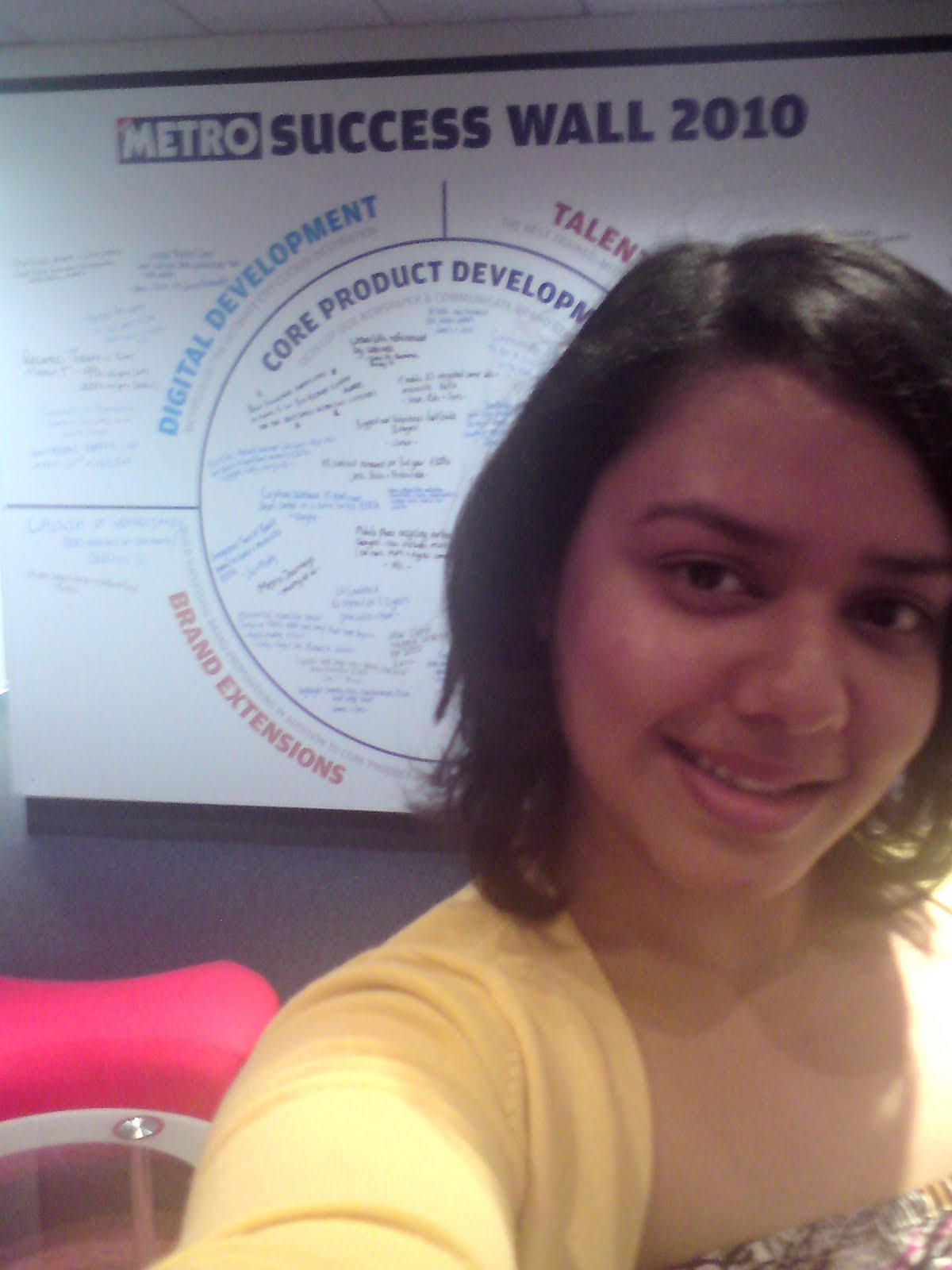
As part of my summer fundraising initiative, I have been working for Metroat the Associated NewspaperLondon head office. Metro is Britain’s third largest newspaper, and the paper is distributed for free at stations every weekday morning. Throughout my education, I have studied media and actively taken part in broadcast media and editing, and it is very interesting to be working in one of the biggest newspaper associations in the country. I currently work for the distribution team, and I would like to kindly thank the team for making feel a part of their group.
The Associated Newspaper London headquarters has quite an impressive interior with its large, super high glass ceiling, spiral staircase, a fountain that flows against black marble, massive lips to sit on, and the glorious koi pond which I walk by every day into the Metro office. When colleagues learned that I was training in diplomacy, the comment was often that this was an office with no diplomatic tact whatsoever. It is quite an... interesting experience to say the least. Below is a link to a short video of where I worked at Metro.
In the next few days, I will begin my journey in Moroccoto study at the Al-Akhawayn UniversityUnited Nations in New York. These trips would not have been possible without the support of a few individuals. I would like to give massive thanks to Edwin, Bhavna, Professor Nourallah, Izzy, Abdalhamid, Tanvir, Bunmi, The Gilbert Murray Trust, and importantly Anthonyfor all the support each and everyone one of them have given me. I would also like to thank all my friends, colleagues and family for providing me well wishes, and having so much faith in me and my work.
Thank you all, and please do follow my progress on this website.
As part of the ‘personal empowerment’seminar, I was invited by the Human Culture Collectiveto speak about “maximising one’s image through social media strategies”. This was an opportunity to discuss how far this blog has taken me and how I was able to build a personal brand through extremely cost-efficient ways. The seminar was held at Birkbeck University. I was quite astounded with just how big the audience was. At least 40 people had shown up.
I was the first speaker to open up about brand social media, followed Sidney Sannidiscussing the world of self-publishing, and finally a video presentation by Julene Siddique. While there were many concerns about issues of privacy and online identity, my discussion was primarily focus on how to broaden one’s horizon through blogs, Facebook, twitter and other social mediums.
I would like to thank the Human Culture Collective for the promotion of this event and the success we had achieved on that night.
If you would like a copy of my presentation, please do leave a comment.
Diplomatic consultant with a special focus on corporate social responsibility, climate change, UN reform, gender justice and nuclear disarmament. My vision is to one day close the gap between civil society and key decision makers for a common cause. I am also in the process of publishing my fiction novel, based on the popular video-game, Street Fighter. With any luck, Capcom will take this on next year.
"Smile and let the world smile with you"!