In many conferences, speakers discuss how organisations and citizens should lobby their government to form a coherent climate change strategy in decreasing the rate of carbon emissions. However very often, the discussion of how big businesses and corporations can play a role in climate change is missed or ignored. This event, hosted by the21st Century Network, had rallied industry experts in examining how businesses are participating in this global issue.
The founder of Cientifica Ltd, Tim Harper, said that environmental issues and politics should be separated if we want big corporations to be involved in climate change negotiations. As the world’s leading source of global business intelligence on nanotechnologies, Tim is familiar with the technical and scientific concepts of climate change. While the use of technology has increased carbon emissions, technology has also provided society with medicine, diagnostics, and an economic advantage. From a technological point of view, climate change alternatives should be commercially attractive, helping businesses to keep cost down while reducing emissions at the same time. The unknown factor is a risk for any corporation.
Mary Rhead-Corr, Executive Director of the United Bank of Carbondiscussed her project that enables businesses to fund rainforest sustainability on a global basis. Stopping deforestation is one of the biggest investments to reducing climate change. If the temperature goes up by even 2 degrees, 20-30% of forests will be lost. Mary suggested that businesses and NGOs together should look into ways in fighting deforestation, creating strategic objectives in protecting trees and re-planting on a large scale.
Graham Hillier from Centre for Process Innovation (CIP)spoke from an engineer point of view, thus looking at materials and considering how to use it efficiently. Human activity is at the heart of climate change; we consume more when we are richer, producing 180% of waste compared to the poor. Therefore we must be tackling the environmental factor with the social factor. To adapt sustainable principles, policy makers and engineers must understand what is ‘possible’ for the UK as opposed to setting unachievable targets.
Two case studies were showcased. Intelligent Energy,led by Vice President Dennis Haytar focused on the use of clean power, and how technology enables users to achieve zero emission applications. Per Regnarsson, Clean World Capital, focused on renewable energy and clean technology in offices in Copenhagen and London. They work with Wind Energy, Solar Energy, Waste2Energy, Water Filtration, Clean Cars, Green housing and efficiency.
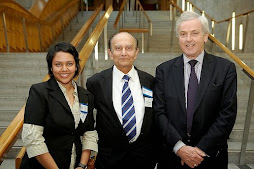
As part of the SOAS’s annual Sir Joseph Hotung International Human Rights Lecture, I attended a conference entitled ‘Foreign Policy and Human Rights: Is there a contradiction?’ To mark this occasion, Lord Patten of Barnes, the co-Chair of the International Crisis Group and of the UK-India Round Table, presented his case on diplomacy as keynote speaker.
Having spent 5 years as the Governor of Hong Kong, much of Lord Patten’s speech was related to his diplomatic experiences in Hong Kong. Hong Kong is prosperous and stable because it has strong British business backing, dating far back from colonial times. It is common to see “UK PLC” in China, however is dismayed that when speaking of business, the topic of human rights is rarely connected. While Dr. Henry Kissinger opened up business and diplomatic relations with China during the 1970s, he ignored the Indo-Chinese tension, which eventually led to China bombing Cambodia. China still has a policy of ‘separating business with politics’ which has led to human rights negligence in the country.
Democracies that govern under human rights law are usually more peaceful and stable that has the best standard of living and business practices, Helsinki being a striking example. However, Lord Patten warned that setting out ethical foreign policies before the government begins its term leads to failure as it is often hard to live up to. Human rights issues cannot be selective as issues interrelate to one another. Yet in the practice of business, it is difficult to practice human rights with the rigidity of commerce law. As in the case of Africa, corruption and civil wars have begun over the ownership of natural resources, and industrial growth and failure to social problems links with business practices. Oil dependency on authoritarian states like in the Arab encourages our democratic idealisation on these States.
Lord Patten stated that “we used to fear mighty states. Now we fear weak states” and eventually problems are exported from powerful, well-developed countries to weaker, less-developed countries which creates the problems of drugs, weapons trade, diseases etc. Diplomacy can be effective if links are made in all areas of foreign policy and human rights. For example, diplomacy should control industries of small arms and need to make UN embargos on arms more effective by tracing the origin of weapons, buy it up and destroy the stockpile to protect civilians. Often in the case of diplomacy, people are treated as “expandable pawns”, where the heroes of real politiques are either “authoritarians” or “revolutionists”. The longer the authoritarianism lasts, the more extreme successors will become.
Lord Patten has made it clear that there is a contradiction between human rights and foreign policy, and that economic development has direct links to social responsibility. Diplomats should get involved in global governance and explore opportunities to weaken the barriers between human rights and foreign policy if we are to reduce the effects of major global issues.
Since being elected as the new coordinator in April 2009, Y-WILPF UK has taken a major turn with its capacity building programme within the Women’s International League for Peace and Freedom. As Y-WILPF’s aim is to empower new and young members in WILPF, the new partnership with Changemakers has enabled Y-WILPF to have access to young women in clubs, schools and colleges across East London. Changemaker’s Development Manager, Marie Lyse Numuhoza and I are working together in bringing young women into Y-WILPF so that they can engage in WILPF activities, fundraise and expand WILPF as an organisation.
To enable new members to be as active as possible, Y-WILPF endeavours to host a Talent Show in April 2010 as part of WILPF’s annual birthday celebration. The Talent Show will be a ticketed event to showcase the work of women through forms of art, drama, dance and other entertainment avenues. In order to organise this mammoth event, Y-WILPF will be recruiting committee members within the network with specific duties. The idea of forming a committee will not only allow new members to learn about WILPF, but will encourage young women to contribute to the growth of WILPF and gain valuable experience from an international organisation.
The Talent Show is not the only event we will be working on. Y-WILPF will be engaged with UK WILPF’s three core campaigns and collaborate in outside events such as the Blockade of Aldermaston in February 2010. It is essential that Y-WILPF members participate in as many events as possible so that they can learn about global issues, network with professionals, and encourage like-minded women to join WILPF.
By recruiting young women through the Y-WILPF committee, we hope that new and young members can share fresh ideas with our current executive members with the aims of making WILPF a stronger and more united organisation. If you are interested, please get in touch with me as soon as possible
In this two day conference, the Institute for Law Accountability and Peace (INLAP)and World Court Project UK have joined to form a steering group in concerns with accountability and the law. The first day constituted of talks from a wide range of experts while the second day enabled participants to discuss techniques on how to empower citizens.
Day One
The conference began with a review of international and domestic Law, which was examined by Nick Grief (Professor of International Law) and Robbie Manson (Co-founder of INLAP). As concerned citizens, we have the right to know how our country is run and what decisions are being made. However there is confusion as to when a country must adhere to domestic or international law in regards to militarism and defence. For example, US forces based in the UK adhere to US law, even though their operations are conducted on British soil. Therefore when is it appropriate to apply international law, and is the government, parliament, ministerial or individuals held accountable when laws are broken? Robbie Manson answered ‘no’, especially if definitions across international law are not concrete, as is the case for the term “crime of aggression”. Without terminologies in international law fully defined in all countries, accountability is less likely to happen.
While it is challenging to apply law to armed conflict, citizens are experiencing difficulties in relating to the government. Ann Feltham (Campaigns against Arms Trade) highlighted the lack of transparency shown by the government. The government’s annual report in the UN and EU bears little information on research conducted and is extremely vague due to commercial confidentiality. Liberal Democrat MP, Norman Baker urged that citizens make use of the ‘Freedom of Information Act’ (2006) to our advantage. However, while the act has enabled organisations like CAAT to retrieve commercial information on the arms trade, how to publicly present this information poses another question.
Dr. Paul Dorfman (University of Warwick) questioned whether the use of nuclear arms is justified and if the same information is known to the government as it is to the public. At present, there is demand for a public inquiry to be made on the Iraq war, as the reason to attack was not only illegal but publically favoured against. Dr. Andrew Blick (Senior Research Fellow) stated that the British parliament is weak with its conduct with the government. The Prime Minister can still declare war without the consent of the parliament, which undermines the system completely. It is not enough for politicians and officials to listen to citizens when parliamentarians cannot enforce the law on its own government.
The decisions that the government make may be linked historically, ignoring domestic and international law altogether. Dr. Nick Ritchie (University of Bradford) revealed that the justification of nuclear arms may be a matter of national identity rather than for national security. In a political point of view, keeping nuclear arms means maintaining a role as the “pivotal power” of the world. There are political fears that the liberation of nuclear arms may damage special foreign relationships. Labour Party MP, Clare Shortagreed that the renewal of the British nuclear system is just an excuse for power, thus encouraging citizens to raise the debate on what Britain’s role should be. If “our political system is broken” then it falls on citizens to urge ministers for legal change.
A key approach to engaging with the government is through opinion polls and campaigning, however each method has its strong and weak points. Milan Rai (Justice Not Vengeance) illustrated that the attack on Iraq still went ahead despite large public demonstrations against the war. Yet, London Mayor, Boris Johnson continued as “Mayors of Peace” after public outcry when he left the position. With accurate and regular information, an action or decision can proceed or be stopped. According to Jenny Jones (Green Group), working with a group/organisation is a useful lobbying tool. By preparing pre-written letters and targeting specific counsellors, a message is likely to be accepted. Furthermore, it is easier to target the media through an organisation as the message behind the campaign is supported by a larger audience.
To round off the first day, case studies on the Trident renewal, War on Terror, and successful interactions between citizens and the government were presented byAngie Zelter (Trident Ploughshares), Gareth Peirce (Solicitor), andJackie Chase (Brighton activist).
DAY TWO
For citizens to make a real impact to transform the British political system, it is essential to make use of resources already available like the Freedom of Information Act, as well as approaching local media and engaging with MPs.
In Day Two of the conference, 4 workshops were conducted to empower participants in discussions on how to engage in dialogue, petitions, face-to-face meetings, holding events, writing to the press and using IT successfully. These networking approaches were presented by David Bohm (MEDACT), Jenny Maxwell (Chair of West Midland CND), Ashley Woods (Media Consultant), and George Farebrother (World Court Project).
A comprehensive guide to empowering citizens will be developed by the World Court Project, however a short guide to ‘Writing to MPs’ and ‘How to Network’ will be available in this blog shortly.
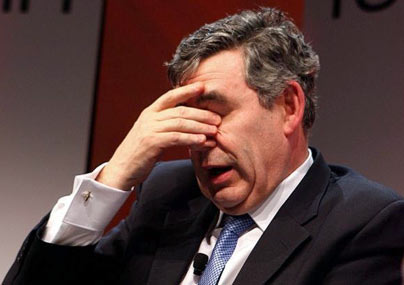
Rt Hon Gordon Brown MP Prime Minister 10 Downing Street, London SW1A 2AA
Dear Prime Minister,
RE: Attend the UN Summit in Copenhagen
On 7-18 December, the United Nations Climate Change Conference (COP 15) will take a place in Copenhagen. COP 15 will hopefully be a crucial milestone in achieving a fair and binding global climate treaty.
While I admire and support Mr. Ed Miliband's efforts to encourage the UK to becoming carbon neutral, I strongly believe it is essential for our Prime Minister to attend the COP 15 summit. With negotiations off track, a strong deal at the final climate treaty summit can only be determined if top politicians with real power are prepared to negotiate. So far, no dealer from the world's richest and most powerful countries had committed to attend.
Climate change is already severely impacting upon the daily lives of thousands of people, and young adults everywhere are one of the key stakeholder groups who will inherit global problems. We need coherent solutions and smart strategies which can be agreed upon by all G8 members and require a higher level of awareness. A fair, ambitious and binding global treaty is our best hope of shifting every single country toward green jobs, energy efficiency, more sustainable lifestyles and clean power. Climate change impacts various issues across the world, including poverty, environmental degradation and the economy, therefore as this issue affects me, your decision will determine how I vote at the next election.
I believe that this summit could launch a historic shift towards a clean-energy, green-recovery future that leaves the climate safer for future generations at an international level. I call upon you, an important member of the G8, to attend the climate change summit and urge the G8 to reach a binding contract to secure our future.
I urge you to show leadership alongside other countries and participate as our head of government in demonstrating the demands of young adults in creating a fair, just and reasonable strategy at COP 15. Your attendance if critical if we are to reach a global treaty.
In June 2009, Prime Minister Gordon Brown announced an independent inquiry into the Iraq war, but the seriousness of the inquiry had already been jeopardised by claims of covering-up evidence. As an organisation that pushes for transparency and renewal of democratic processes, Action for UN Renewalheld a public meeting to establish the truth about the Iraq War and put forward recommendations for the investigation. The event attracted a large audience, which led to an emotionally stimulated debate driven by a handful of Iraqi activists. We would like to thank the World Disarmament CampaignandRita Payne (Chair) from the Commonwealth Journalists Associationfor supporting this event.
The Washington Post stated, “As of a relationship between Saddam Hussein and Al Qaeda, the US Intelligence agencies reported that no such relationship existed.” Therefore, what were Bush and Blair’s reason to instigate war? In the absence of an Iraq spokesperson, distinguished speakers, including General Sir Hugh Beach, Robert Fox (Evening Standard), Nick Grief (Prof., International Law), Nicholas Jones (Former BBC Political Correspondent ), and Vijay Mehta (Chair, Action for UN Renewal) explored various issues establishing the reasons, legality, and hidden agendas to the build-up to the war.
To open the debate,Vijay Mehtafirmly indicated that the war on Iraq was a violation of the UN Charter, the Universal Declaration of Human Rights and America’s War Powers Act.Over 1.3 million Iraqi’s were killed against 4,500 US troops and 179 British, and even till this day more than 3 million people are displaced refugees. The decision to invade Iraq was taken well before 2003, and was certainly a “crime of aggression.” The 9/11 attack was the perfect excuse for Britain and America to declare into a pre-planned military adventure; in Sir Hugh Beach’s view, the perfect excuse to overthrow Saddam Hussein. While the former Iraqi President committed numerous humanitarian crimes to his people, no humanitarian crisis like the gassing of the Kurds in 1988 had taken place in 2003. The argument begins whether the West had the right to declare war on the assumption that Iraq held weapons of mass destruction. It seemed quite clear that the Bush administration was continually justifying its decision as a means to protect the nation from “the continuing threat posed by Iraq,” however even now, there is no evidence of this.
As a lawyer,Nicholas Griefsuggested that Tony Blair should be prosecuted for his ‘crime of aggression’ behaviour, however even British parliamentary law does not have the power to veto declaration of war, nor does it have set regulations in conducting ‘crime of aggression’ investigation. Former General Secretary Kofi Annan indicated the war “was not in conformity with the UN charter from our point of view, from the charter point of view, [therefore] it was illegal.” Yet America to have declared war on Iraq despite pressure from the Security Council against the decision shows that the UN is in serious need of renewal as the US should not solitarily speak or act on behalf of the Security Council.
Robert Foxwas sceptical that the war inquiry would truly establish evidence for war, due to what Robert described as “media massage.” He asked whether intelligence about the inquiry is credible, especially with the amount of ‘phoney propaganda’ and false documentation that is planted in the British and American media. Robert affirmed that the media dominates controls and manages the news to deceive its country and people. To confirm Robert’s claim, Nicholas Jones read out a conversation between media mogul Rupert Murdoch and Tony Blair, with Murdoch praising Blair with the decision to go to war and his promise to back Blair through his media channels. It quickly became apparent that Murdoch was telling the truth when Nicholas exhibited front cover pages of The Sun supporting Blair’s re-election as Prime Minister and grand support for the Iraq War, with ridiculous headline news such as “The Sun takes on the Taliban”.
Recommendations
The Iraq inquiry should be a full transparent and accountable public inquiry with UN civil servants, weapons inspectors, leaders and others to come forward with evidence with its decision to war. The investigation should also include allegations of human rights violation and abuses committed by the British, while training remaining troops in peacekeeping, conflict prevention and reconciliation. The authorisation to go to war by the UK government and the Security Council urgently need to be reformed to prevent future conflicts. It was also recommended that the UK government should compensate the people of Iraq by restoring infrastructure and national heritage sites that were damaged or destroyed during the war.
The public will need to put pressure on the government to make sure the war inquiry has been fully investigated without the disruption of ‘media massage’ messages to enable full transparency. While it is important to hold the former Prime Minister account in co-leading the war, one person cannot take full responsibility for a near decade war, therefore the inquiry needs to establish allies and other instigators to take account.
Diplomatic consultant with a special focus on corporate social responsibility, climate change, UN reform, gender justice and nuclear disarmament. My vision is to one day close the gap between civil society and key decision makers for a common cause. I am also in the process of publishing my fiction novel, based on the popular video-game, Street Fighter. With any luck, Capcom will take this on next year.
"Smile and let the world smile with you"!